Drums for Kids: What Actually Works at Age 5, 7, and 10
29 June 2026
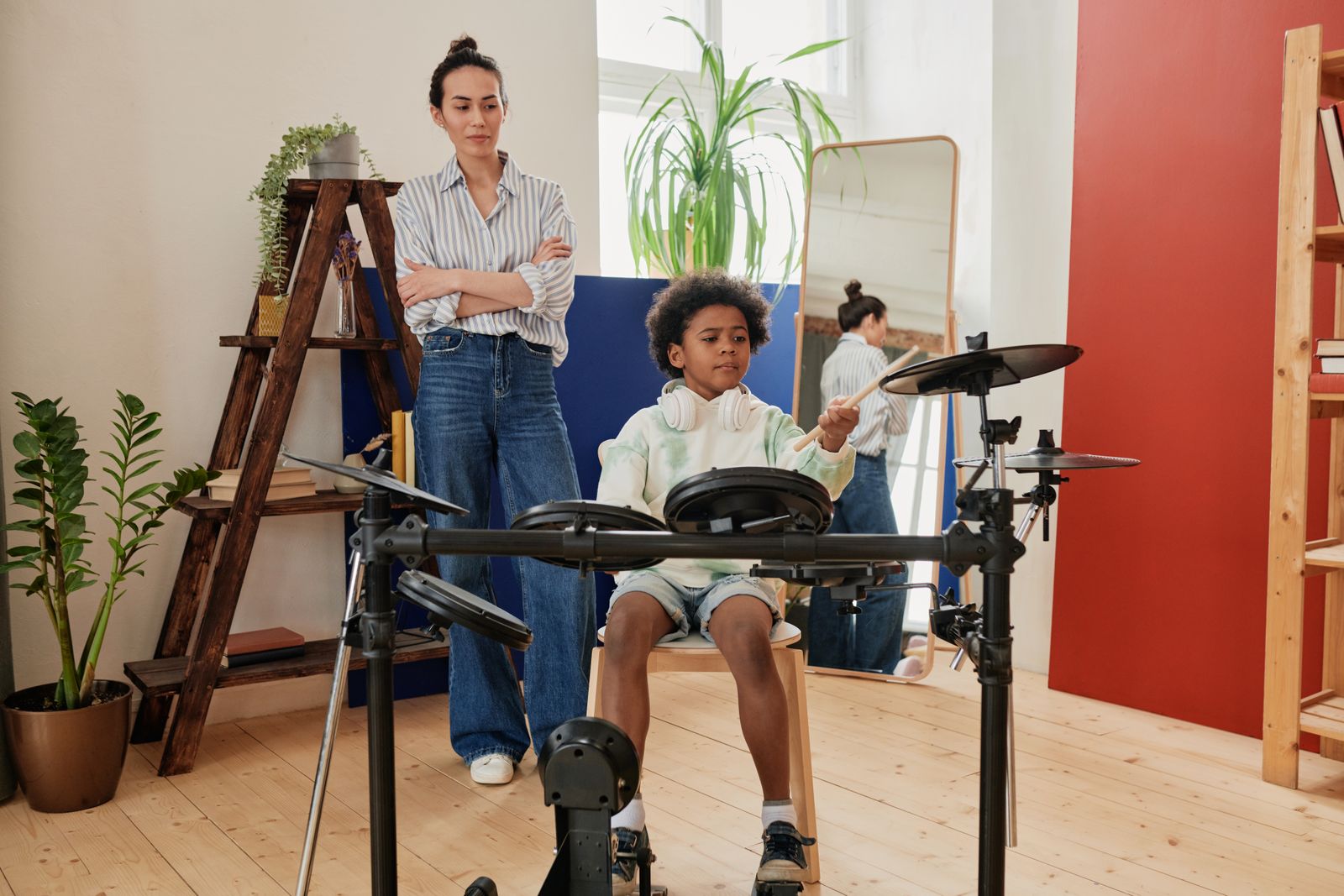
Parents ask me the same question in different forms. "My child is six — is that too young?" "My son is nine — have we missed the window?" "My daughter can't sit still for five minutes — is this even for her?"
The answers depend far more on the specific child than on the specific age. But after years of teaching children from five to fourteen, I can say quite precisely what to expect at each stage — and which drum setups actually work for each age group.
Age 5: It's Possible, But Calibrate Your Expectations
Five is the lower threshold where lessons make genuine sense. Not because young children lack rhythm — they usually have plenty — but because they need an instrument proportioned to their body and a concentration span that can sustain at least 20–25 minutes.
What works well at five: simple rhythmic exercises, imitation ("play like me"), basic hand-foot coordination. Young children learn primarily through repetition and play. The lesson needs to feel like fun almost the entire time — not disciplined exercise.
What doesn't work: reading notation, complex coordination tasks, extended verbal explanation. A five-year-old wants to hit something and hear a result. Give them that satisfaction.
For the kit itself: junior drum sets from Roland, Pearl, or Tama are appropriate at this age. The critical factor is proportion — a small child on a full-height throne and a full-size bass drum will be playing with their elbows at ear level, which is neither functional nor comfortable. The instrument needs to fit the body.
Age 7: The Real Starting Point

Seven is my favourite age for beginners. Not because earlier is bad, but because most seven-year-olds can follow structured instruction, hear when they're making a mistake, and work towards a defined goal — "play this song" or "learn this rhythm pattern."
Concentration holds for a 45-minute lesson. Coordination develops quickly. And perhaps most importantly: motivation is more durable. Five-year-olds sometimes play with huge enthusiasm and three months later can't quite remember why they liked it. At seven, children can already articulate why they want to play.
At this age, a kids' drum kit can already be semi-full-sized — just properly adjusted. Correct throne height, heads tuned on the lighter side. Pearl Roadshow Jr. or Mapex Tornado Junior are solid acoustic options. If you live in a flat — the Roland TD-1K or Alesis Nitro Mesh with a junior throne is a very workable starting point.
Age 10: Almost Like an Adult Learner
At ten, I teach in essentially the same way I teach teenagers and adult students. Concentration is strong, abstract thinking is developed, and for the first time children can genuinely absorb the "why" behind technique — not just the how.
The difference from younger students is that ten-year-olds usually arrive with a clear stylistic preference. "I want to play metal" or "I love this band." That specificity is a huge advantage in learning — we work directly with the music the child is actually excited about.
As for the instrument: a full-sized kit is entirely appropriate at ten. You don't need to wait for them to grow any further.
Which Drum Setup Works at Which Age
A practical summary:
- Ages 5–6: Junior kit, set low. Pearl, Tama, and Roland all have good options. Focus on proportions, not brand.
- Ages 7–9: Junior kit or a light full-sized kit with a lowered throne. Electronic is fine — Roland TD-1K works well. Mesh pads over rubber if going electronic.
- Ages 10+: Full-sized acoustic or electronic. No special "kids" variants needed.
At every age: avoid toy drum sets sold in general toy or department stores. They lack proper rebound and teach incorrect technique from the start. A decent practice pad from a music brand is genuinely more useful than a plastic mini-kit at a low price.
What Parents Should Expect
Three things worth being prepared for:
The noise. Drums are loud. If you don't have a space where your child can play without disturbing anyone — look at electronic drums from the start. A child restricted to "only on Saturdays" because of neighbours is not going to make progress.
Inconsistency. Especially with 5–7-year-olds, motivation varies. One month they're passionate, the next they're distracted by something else. This is normal — not a sign they should quit. Don't push too hard; but don't abandon at the first sign of a difficult week either.
Your involvement. A child who has a short practice session at home — even ten minutes of showing a parent what they learned — develops faster than one left to "just play around." You don't need to know anything about drums. Listening matters.
If you're not sure whether your child is ready — a trial lesson is exactly the right place to find out. Come together, your child sits at the kit and hits things, and you watch how they respond. Everything else can wait until after that.